We independently review every item we recommend. If you buy through our links, we may earn a small commission that helps us continue to make quality content for you. Thanks for your support!
ChargePoint Home Flex EV Charging Station Review
A powerful charger with smart-charging capability in a compact, stylish form
Table of Contents:
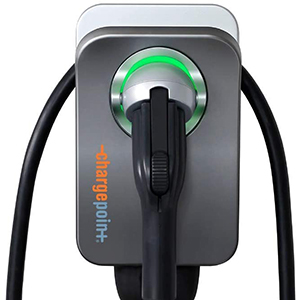
ChargePoint is no stranger to the electric vehicle charging station market, and their latest offering, the ChargePoint Home Flex, is a second-generation product in their residential hardware line. Arriving about four and a half years after the original ChargePoint Home, their newest unit has since become one of the most popular EV chargers in North America.
With its fast charging speeds, WiFi connectivity and useful smart features, and a charging cable that’s able to handle extreme temperatures, it certainly seems like the ChargePoint Home Flex has a lot going for it. That’s why we decided to test it out over the course of several months to see if it lives up to the hype.
Misses
- Doesn’t have the ability to power share
- Consumer has to install the power cable to the unit themselves
- Not NEMA 4 rated, meaning that it’s not as protected against heavy rainfall
ChargePoint offers a fantastic plug-in installation video for the ChargePoint Home Flex that shows you how to unpack it, as well as the included parts, before showing you how to install it. It’s pretty simple– you basically just need to drill 3 holes in the wall (preferably along a stud for extra stability) within reach of your power outlet. An installation template, drill bit, driver, and screws are all provided to make things even easier.
Strangely, you will have to install the power cable to the unit yourself, unlike nearly every other EV charging station out there. Thankfully, however, it’s pretty simple: you only need to slide the cable into the wall unit, slide the three wires into place, snap the tabs down, and plug in a communications connector to complete that installation.
They also offer a hardwired installation video, but as always, we like to remind you that it’s best to hire a licensed and bonded electrician to safely install your electric vehicle charging equipment.
The ChargePoint Home Flex is just as flexible as its name implies, allowing you to charge your electric vehicle at 6, 24, 32, 40, 48 or 50 amps. According to ChargePoint, you should be able to add about 37 miles of range per hour at 50 amps, depending on your EV’s efficiency.
This charger is capable of automatically restarting should you run into a power outage. Once the power has been restored, the ChargePoint Home Flex will restart the charging process in about a minute. Unfortunately, this unit is unable to power share, allowing two Home Flex units to share a single circuit. Competitors like the Tesla Wall Connector do have the ability to power share, which can be really convenient in multiple-EV households.
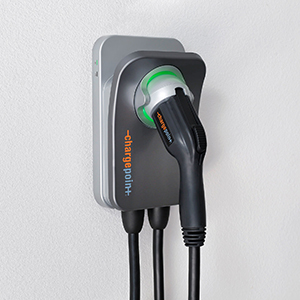
We’d be remiss in not mentioning this unit’s integrated connector holster. Easily one of the best holsters we’ve encountered so far, it swivels up when you remove the connector, allowing for easy reholstering when you're finished charging. The holster has a tapered edge, allowing for an easy return even if your aim isn’t perfect. It's also backlit, which is very handy in dark garages or in outdoor installations without a lot of light.
Key Specs of the ChargePoint Home Flex
- Charger: AC Level 2
- AC Connector: SAE J1772, NACS
- Power Input: Hardwired, NEMA 6-50 plug, NEMA 14-50 plug
- Rated Current: 50 Amps
- Adjustable Current: 16-50 Amps
- Maximum Power: 12 kW
- Dimensions (without cable): 11.19" x 7.06" x 5.2"
- Cable length: 23 ft
- Connectivity: Wi-Fi
- Safety Certified: Yes
Testing
We take pride in offering our readers and viewers a thorough review of the products we’ve tried, and this one was no exception. For those of you living in areas that experience very low temperatures, we know you need to have a charging cable that you can rely on.
The Cable Deep Freeze Test
Since we’re serious about our cold-weather testing, we put the ChargePoint Home Flex into a commercial ice cream freezer for over 14 hours in order to see how the flexibility of the charging cable would hold up in extremely low temperatures. When we pulled it out, the temperature in the freezer measured at -18° F, but it was easy to see that the cable remained nice and pliant despite being frozen. We didn’t have any trouble unwinding or rewinding the cable, so we can definitely recommend this one for very cold environments.
The ChargePoint Home Flex came away with a score of 4.3 out of 5 stars overall. It seems well-deserving of its reputation, and it’s definitely an EV charger that we can recommend.
The ChargePoint Home Flex is available from EVChargingStation's Shop for $539.00 (as of January 21, 2026). Check out the video above and let us know your thoughts below.
ChargePoint Home Flex EV Charging Station Review
A powerful charger with smart-charging capability in a compact, stylish form
Table of Contents:
ChargePoint is no stranger to the electric vehicle charging station market, and their latest offering, the ChargePoint Home Flex, is a second-generation product in their residential hardware line. Arriving about four and a half years after the original ChargePoint Home, their newest unit has since become one of the most popular EV chargers in North America.
With its fast charging speeds, WiFi connectivity and useful smart features, and a charging cable that’s able to handle extreme temperatures, it certainly seems like the ChargePoint Home Flex has a lot going for it. That’s why we decided to test it out over the course of several months to see if it lives up to the hype.
Misses
- Doesn’t have the ability to power share
- Consumer has to install the power cable to the unit themselves
- Not NEMA 4 rated, meaning that it’s not as protected against heavy rainfall
ChargePoint offers a fantastic plug-in installation video for the ChargePoint Home Flex that shows you how to unpack it, as well as the included parts, before showing you how to install it. It’s pretty simple– you basically just need to drill 3 holes in the wall (preferably along a stud for extra stability) within reach of your power outlet. An installation template, drill bit, driver, and screws are all provided to make things even easier.
Strangely, you will have to install the power cable to the unit yourself, unlike nearly every other EV charging station out there. Thankfully, however, it’s pretty simple: you only need to slide the cable into the wall unit, slide the three wires into place, snap the tabs down, and plug in a communications connector to complete that installation.
They also offer a hardwired installation video, but as always, we like to remind you that it’s best to hire a licensed and bonded electrician to safely install your electric vehicle charging equipment.
Key Specs of the ChargePoint Home Flex
- Charger: AC Level 2
- AC Connector: SAE J1772, NACS
- Power Input: Hardwired, NEMA 6-50 plug, NEMA 14-50 plug
- Rated Current: 50 Amps
- Adjustable Current: 16-50 Amps
- Maximum Power: 12 kW
- Dimensions (without cable): 11.19" x 7.06" x 5.2"
- Cable length: 23 ft
- Connectivity: Wi-Fi
- Safety Certified: Yes
The ChargePoint Home Flex is just as flexible as its name implies, allowing you to charge your electric vehicle at 6, 24, 32, 40, 48 or 50 amps. According to ChargePoint, you should be able to add about 37 miles of range per hour at 50 amps, depending on your EV’s efficiency.
This charger is capable of automatically restarting should you run into a power outage. Once the power has been restored, the ChargePoint Home Flex will restart the charging process in about a minute. Unfortunately, this unit is unable to power share, allowing two Home Flex units to share a single circuit. Competitors like the Tesla Wall Connector do have the ability to power share, which can be really convenient in multiple-EV households.
We’d be remiss in not mentioning this unit’s integrated connector holster. Easily one of the best holsters we’ve encountered so far, it swivels up when you remove the connector, allowing for easy reholstering when you're finished charging. The holster has a tapered edge, allowing for an easy return even if your aim isn’t perfect. It's also backlit, which is very handy in dark garages or in outdoor installations without a lot of light.
Testing
We take pride in offering our readers and viewers a thorough review of the products we’ve tried, and this one was no exception. For those of you living in areas that experience very low temperatures, we know you need to have a charging cable that you can rely on.
The Cable Deep Freeze Test
Since we’re serious about our cold-weather testing, we put the ChargePoint Home Flex into a commercial ice cream freezer for over 14 hours in order to see how the flexibility of the charging cable would hold up in extremely low temperatures. When we pulled it out, the temperature in the freezer measured at -18° F, but it was easy to see that the cable remained nice and pliant despite being frozen. We didn’t have any trouble unwinding or rewinding the cable, so we can definitely recommend this one for very cold environments.
The ChargePoint Home Flex came away with a score of 4.3 out of 5 stars overall. It seems well-deserving of its reputation, and it’s definitely an EV charger that we can recommend.
The ChargePoint Home Flex is available from EVChargingStation's Shop for $539.00 (as of January 21, 2026). Check out the video above and let us know your thoughts below.



The current information shows the Chargepoint Home Flex is capable of charging at 80 amp/19.2 KW when hardwired with 100 amp circuit. Is it possible to give an update on this home charger?
We bought a brand new 2026 Kia EV9 . I bought one charger and it kept failing after 30 seconds. I returned that an purchased the ChargePoint 50, plugin.
We have a dedicated 220 volt dedicated circuit. This ChargePoint keeps interrupting after a minute or so. The EV9 charges on Level 1 and Level 3 charger. We can’t charge on any Level 2 charger we have bought so far. I am ripping my hair out
Does the circuit have a GFCI breaker? That can be a cause. My county only requires it for outdoor receptacles but not indoor. My electrician mentioned someone’s outdoor setup tripped a lot like that. They changed to hardwire without GFCI to resolve it.