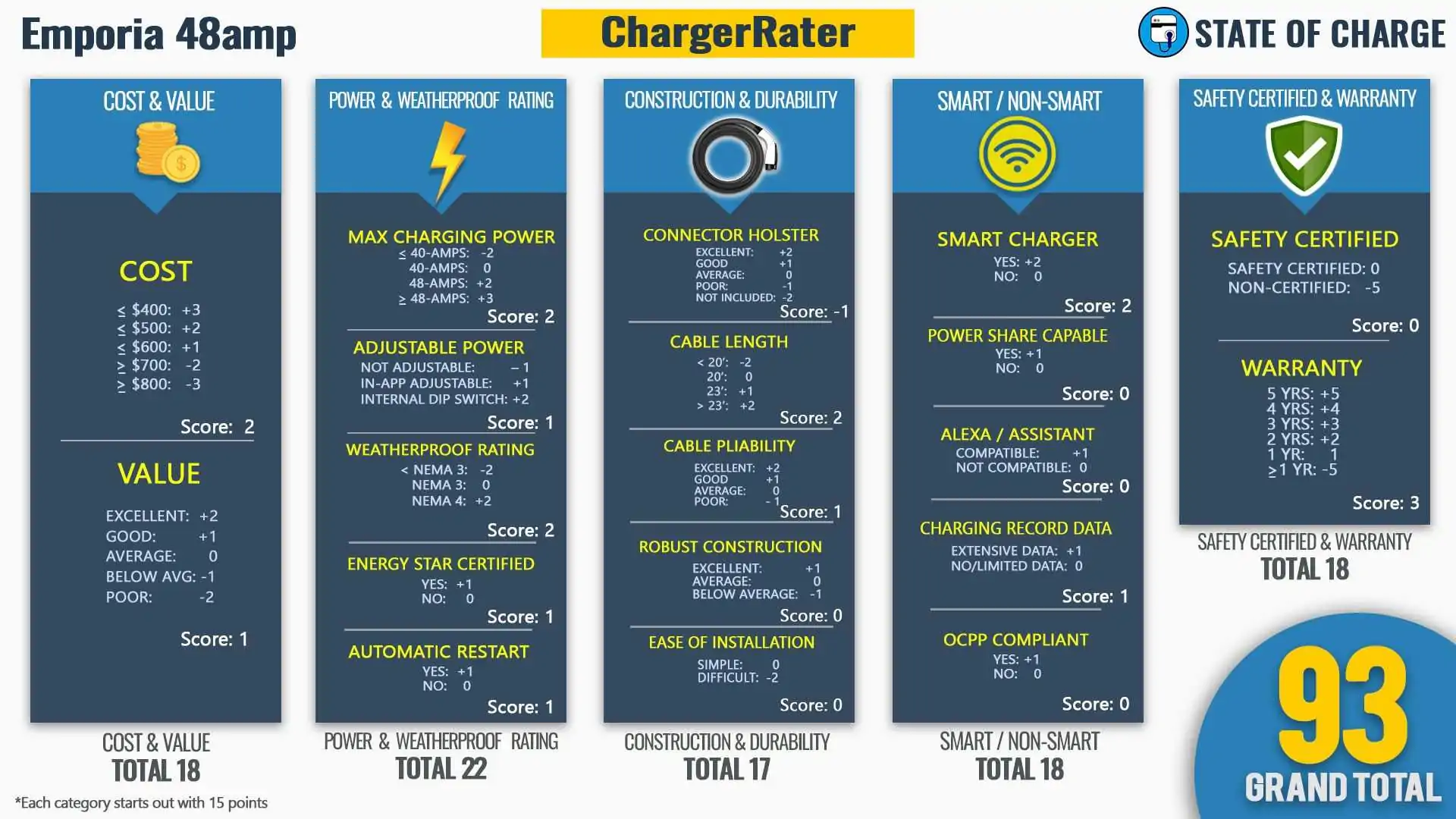
We independently review every item we recommend. If you buy through our links, we may earn a small commission that helps us continue to make quality content for you. Thanks for your support!
Emporia 48-Amp EV Charging Station Review
A high-powered EV charging station with great features that’s easy on the wallet
Table of Contents:
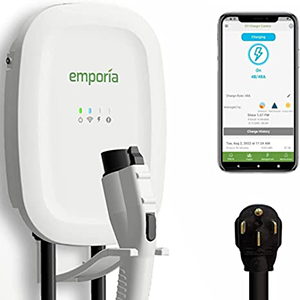
Emporia is no stranger to the smart home energy management scene, but did you know that it now has its own EV charging station? The Emporia 48-amp EV charger quickly gained a lot of interest when it first came out earlier this year, and once it finally became UL safety certified, I knew that I’d have to test this one out. Thanks to a combination of its high 48-amp power, smart charging features, and its integration with Emporia’s other home energy-saving and monitoring devices, there’s no doubt that the Emporia EV charging station will make a splash on the EVSE scene.
Of course, expectations and reality don’t always line up, so once I got a hold of one of the units, I made sure to use it for a while before giving it my full review.
- Charger: AC Level 2
- AC Connector: SAE J1772, NACS
- Power Input: Hardwired, NEMA 14-50 plug
- Rated Current: 48 Amps
- Adjustable Current: 6-48 Amps
- Maximum Power: 11.5
- Dimensions (without cable): 12.6" x 9" x 3.4"
- Cable length: 24 ft
- Connectivity: Wi-Fi
- Safety Certified: Yes
The Emporia comes with nearly everything you need for the plug-in installation outside of a Phillips head screwdriver– screws, drywall anchors, an Allen wrench, and the unit itself. The bracket that mounts the unit to the wall is already attached to the back at delivery, so after removing the screws to pop it off, you can install it in whatever location is most convenient for you. Considering that the power cable is longer than most at almost two feet in length, you have a lot more flexibility in your mounting options than with some chargers. Then all you need to do is insert the NEMA 14-50 plug into your dedicated outlet and you’re ready to charge.
The connection holster can either be attached to the unit itself or in another location that works better for you. When attaching it to the unit, all you need to do is slide the holster mount into the provided grooves to lock it into place, and then add the bracket’s third screw to really secure it. But if you’d rather mount the holster closer to the charging port of your car (or anywhere else, for that matter), you can easily do so with the extra screws that Emporia provides.
The Emporia EV charging station can also be hardwired for extra charging power. Remember, any time you install a hardwired EV charging station in your home, it’s always a good idea to hire a licensed and bonded electrician to make sure it’s done correctly for maximum safety.
The Emporia can deliver up to 9.6 kW and 40 amps if it’s plugged in using the NEMA 14-50 plug, and up to 11.5 kW at 48 amps if it’s hardwired. Not all vehicles can accept this much power, but the Emporia charger will only provide the amount of power that your EV can safely accept, making it a good choice for your charging needs regardless of brand. It’s also UL safety certified, Energy Star certified, and the enclosure is a watertight NEMA Type 4 made to withstand the elements.
As long as you’ve got a WiFi connection handy, the Emporia can provide you with a variety of smart services to make your charging experience even better. Not only can you monitor charging through the app, but you can also adjust your EV’s charging rate and schedule charging to take advantage of variable utility rates. On top of that, the Emporia EV charging station can pair with Emporia’s other smart devices to do things like automatically charge with excess solar power and curb charging during periods of peak demand.
I can’t say that I was impressed by the connection holster. The connector faces upward, exposing it to rain and dust unless you use the rubber cap, and the rubber cap is just a hassle to take on and off. I much prefer connector holsters where the connector plugs into the unit. The holster also prevents you from easily grabbing and pulling the connector out by the handle– the design forces you to grab it by the plug and maneuver it out of the cradle instead, requiring both hands for the task. There’s no way to grab the connector by the handle and go straight to charging, and I think that’s terrible.
The only redeeming factor of the connection holster is the fact that it’s made of metal, not plastic. So you may want to consider purchasing an aftermarket connector holster with cable management like this one if you can’t stand the original.
Testing
I make sure to put all of the EV chargers I review through a variety of tests that simulate common experiences we encounter in everyday life. The basic specs of any EV charging station are critical to know about before buying one, but I also believe that it’s important for consumers to know about the durability of a charging station’s connector as well as its performance in extremely cold weather before they make a purchase.
The Drop Test
Everyone drops the connector now and then, so it only makes sense for me to test the Emporia’s durability so that you know what to expect as a buyer. I drop the conector from about chest height to a hard concrete floor, five times in a row, and then check it over for any damage that could lead to expensive repairs or even outright replacement. The Emporia came away from my rough handling with little more than a few scuffs, so I’m pleased to report that it’s a strong, well-made connector.
The Cable Deep Freeze Test
Our deep freeze tests always garner a lot of interest, so there’s no way we’d pass over the chance to put another charger through this particular experiment. This time around, I left the Emporia EV charger in a commercial ice cream freezer for over 24 hours to see how it would hold up under extreme cold. The interior temperature measured at -6.5° F (-21.4° C) when we pulled the unit out, and I could hear the cable cracking as I unrolled it. However, in spite of the Emporia’s big, thick cable, I was able to unwind it and manipulate it into larger loops much better than I’d expected. It turned out to be stiff but bendable, and I would be able to recommend it for cold weather climates and outdoor installations.
The Emporia Classic crossed the finish line with an overall score of 4.2 stars out of 5. It’s a very good unit, and a few minor tweaks, it could easily become outstanding.
The Emporia is available from EVChargingStation's Shop for $409.00 (as of November 18, 2025). Take a look at my full review in the video above and tell me what you think about the Emporia in the comments below.
Emporia 48-AmpEV Charging Station Review
A high-powered EV charging station with great features that’s easy on the wallet
Table of Contents:
Emporia is no stranger to the smart home energy management scene, but did you know that it now has its own EV charging station? The Emporia 48-amp EV charger quickly gained a lot of interest when it first came out earlier this year, and once it finally became UL safety certified, I knew that I’d have to test this one out. Thanks to a combination of its high 48-amp power, smart charging features, and its integration with Emporia’s other home energy-saving and monitoring devices, there’s no doubt that the Emporia EV charging station will make a splash on the EVSE scene.
Of course, expectations and reality don’t always line up, so once I got a hold of one of the units, I made sure to use it for a while before giving it my full review.
- Charger: AC Level 2
- AC Connector: SAE J1772, NACS
- Power Input: Hardwired, NEMA 14-50 plug
- Rated Current: 48 amps
- Adjustable Current: 6-48 amps
- Maximum Power: 11.5 kW
- Dimensions (without cable): 12.6" x 9" x 3.4"
- Cable length: 24 ft
- Connectivity: Wi-Fi
- Safety Certified: Yes
The Emporia comes with nearly everything you need for the plug-in installation outside of a Phillips head screwdriver– screws, drywall anchors, an Allen wrench, and the unit itself. The bracket that mounts the unit to the wall is already attached to the back at delivery, so after removing the screws to pop it off, you can install it in whatever location is most convenient for you. Considering that the power cable is longer than most at almost two feet in length, you have a lot more flexibility in your mounting options than with some chargers. Then all you need to do is insert the NEMA 14-50 plug into your dedicated outlet and you’re ready to charge.
The connection holster can either be attached to the unit itself or in another location that works better for you. When attaching it to the unit, all you need to do is slide the holster mount into the provided grooves to lock it into place, and then add the bracket’s third screw to really secure it. But if you’d rather mount the holster closer to the charging port of your car (or anywhere else, for that matter), you can easily do so with the extra screws that Emporia provides.
The Emporia EV charging station can also be hardwired for extra charging power. Remember, any time you install a hardwired EV charging station in your home, it’s always a good idea to hire a licensed and bonded electrician to make sure it’s done correctly for maximum safety.
- Very good price
- Powerful, 48-amp delivery
- Fits well into Emporia’s ecosystem of smart home energy devices
Misses
- Thick, heavy cable
- Terrible connector holster
- Not Amazon Alexa or Google Assistant compatible
The Emporia can deliver up to 9.6 kW and 40 amps if it’s plugged in using the NEMA 14-50 plug, and up to 11.5 kW at 48 amps if it’s hardwired. Not all vehicles can accept this much power, but the Emporia charger will only provide the amount of power that your EV can safely accept, making it a good choice for your charging needs regardless of brand. It’s also UL safety certified, Energy Star certified, and the enclosure is a watertight NEMA Type 4 made to withstand the elements.
As long as you’ve got a WiFi connection handy, the Emporia can provide you with a variety of smart services to make your charging experience even better. Not only can you monitor charging through the app, but you can also adjust your EV’s charging rate and schedule charging to take advantage of variable utility rates. On top of that, the Emporia EV charging station can pair with Emporia’s other smart devices to do things like automatically charge with excess solar power and curb charging during periods of peak demand.
I can’t say that I was impressed by the connection holster. The connector faces upward, exposing it to rain and dust unless you use the rubber cap, and the rubber cap is just a hassle to take on and off. I much prefer connector holsters where the connector plugs into the unit. The holster also prevents you from easily grabbing and pulling the connector out by the handle– the design forces you to grab it by the plug and maneuver it out of the cradle instead, requiring both hands for the task. There’s no way to grab the connector by the handle and go straight to charging, and I think that’s terrible.
The only redeeming factor of the connection holster is the fact that it’s made of metal, not plastic. So you may want to consider purchasing an aftermarket connector holster with cable management like this one if you can’t stand the original.
Testing
To provide you, as a consumer, with the best overall picture of how an EV charging station operates during everyday use, I subject each one I review to a series of tests. By simulating real-world conditions, I can demonstrate how well a charging station will perform under various scenarios, including extreme temperatures, rough handling, and power outages. That way, you’re more likely to purchase an EVSE that actually fits your needs.
The Extreme Heat Test
To see how well an EV charging station can handle extreme heat, such as summertime in the American Southwest, I put a heat lamp in front of it for about two hours to get the surface temperature to about 120° F (48.89° C). The point is to make sure that the unit will still deliver full power without derating or shutting off when it overheats. I plugged in a Porsche Macan for the test, and checked back in three hours. The Emporia Pro charged the Macan at full power the entire time, even though the surface temperature of the unit eventually rose to about 166° F (74.4° C). That’s a pass on the Extreme Heat Test.
The Automatic Restart Test
With the Automatic Restart Test, I have the charger actively charging an electric vehicle, and I kill power to the circuit to simulate a power outage before restoring the power. What I want to see is the charger re-engaging the electric vehicle and continuing to charge. We’ve noticed that some chargers get stuck in a fault state and don’t start charging the EV again, which is problematic. I plugged the Porsche Macan in for this test as well, and the Emporia Pro immediately resumed charging after the power interruption. That’s another pass.
The Cable Deep Freeze Test
Those of us who live in a northern state, or even Canada, know that cold-weather cable pliability is incredibly important as well. In order to test that, I put the Emporia Pro in a deep freezer for about 30 hours, where it reached a temperature of -12° F (-24.4° C). The thin cable immediately began to frost up after I pulled it out of the freezer, and I was able to unwind it and re-coil it very easily. This was an excellent-performing cable, and yet another pass for the Emporia Pro.
The Frozen Connector Drop Test
Since the unit was still frozen, it was the perfect time for me to conduct my Frozen Connector Drop Test. I dropped the connector five times onto the concrete floor of my garage to see how it would handle rough handling. I don’t love this particular brand of connector, but it handled the test without picking up a single scratch, so the Emporia Pro passes this test as well.
The Cold Weather Startup Test
To round out the cold-weather-related testing, I decided to plug the frozen charging station into the Porsche Macan to see if it powered up and worked well while it was still cold. I plugged it in, watched the initiation lights turn on, and the Emporia Pro started supplying power. That’s yet another pass for this charging station.
The Emporia Classic crossed the finish line with an overall score of 4.2 stars out of 5. It’s a very good unit, and a few minor tweaks, it could easily become outstanding.
The Emporia is available from EVChargingStation's Shop for $409.00 (as of November 18, 2025). Take a look at my full review in the video above and tell me what you think about the Emporia in the comments below.

YOU MIGHT ALSO BE INTERESTED IN:


Hi Tom, I live in New Hampshire and in a townhouse with 125 amp service. It looks like this Emporia charger will work well for my unit. I own a 2023 Volvo XC40 . Please tell me what your thoughts are.
P.S. I have gained so much knowledge from watching your u tub videos . I really do appreciate all of your hard work. Thank you.
John
I have Emporia 48-Amp EV Charging Station. I would like to extend or replace the charging cable to the EV. What are my options or if anyone has any recommendations. I would like to be able to go 40 to 50 FT.
Grand Total score should now be 94 as current price is $399 (Cost Score should be correctly updated to +3 (not the current +2) as it is below $400.
And perhaps another point for Value Score to +3 since current price is Excellent (from current +2 for Good Value score). Which would then bring Grand Total score to 95 🙂
Thanks for your excellent reviews/videos (looking forward to more Equinox EV charging, etc ones)!
Very thankful to you for your diligent work in creating this extensive comparison and review. I’ve been watching your videos for a while now and finally we are at the point where we wish to purchase an EV. Perfect timing since this video is so helpful to us in choosing a Level-2 EVSE. The Emporia looks most appealing to us.